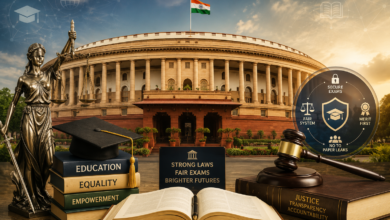

National Education Policy 2026 Pushes Skill-Based Learning Across Indian Colleges
Government mandates internship credits and industry-linked courses to improve graduate employability


New Delhi, February 25, 2026: In a major reform aimed at transforming higher education, the Ministry of Education has directed universities and autonomous colleges to implement compulsory skill-based credits from the 2026–27 academic session. The move is aligned with the broader goals of the Government of India to strengthen employability and reduce the gap between academic knowledge and industry expectations.
Under the revised framework, all undergraduate students will be required to complete at least one certified internship, apprenticeship, or field-based project before graduation. Institutions affiliated with the University Grants Commission will incorporate practical training modules into arts, commerce, science, and professional degree programs.
Officials said the reform places strong emphasis on experiential learning. Students will earn academic credits through hands-on exposure in sectors such as renewable energy, digital marketing, healthcare assistance, financial services, and rural entrepreneurship. Colleges are being encouraged to sign Memorandums of Understanding with local industries and startups to provide structured internship opportunities.
The policy also introduces short-term certification courses in communication skills, data handling, financial literacy, and emerging technologies. These courses will be delivered both offline and through government-backed digital platforms to ensure accessibility for students in remote areas.
Education experts believe this change marks a decisive shift from rote-based learning to outcome-driven education. According to ministry sources, graduate employability surveys have consistently highlighted the need for practical skills alongside theoretical knowledge. By integrating internships into degree programs, authorities aim to make students workplace-ready upon completion of their studies.
However, some academic leaders have raised concerns about infrastructure readiness and faculty workload. The ministry has assured institutions that additional funding and digital resources will be provided to support smooth implementation.
With India’s youth population expected to remain a key economic driver, policymakers argue that skill-oriented reforms are essential to sustaining growth. The success of this initiative will be closely monitored over the next two academic years.