
NASA Icon Sunita Williams Retires at 60 After Legendary Space Career
At the age of 60, Sunita Williams officially retired from active service, concluding a career that spanned more than two decades with NASA.

Created with AIPRM Prompt “SEO-optimized Long Form news articles”
NASA Icon Sunita Williams Retires at 60 After Legendary Space Career
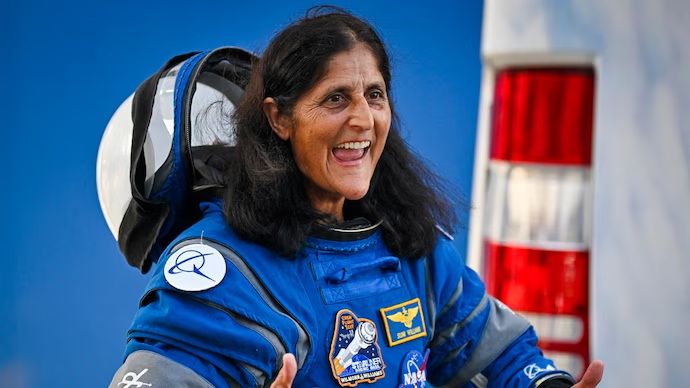
The global space community paused in admiration and gratitude as Sunita Lyn Williams, one of NASA’s most respected and recognizable astronauts, officially retired at the age of 60, bringing an extraordinary chapter of space exploration to a close. Her retirement marks not just the end of a professional journey, but the conclusion of an era defined by courage, discipline, and an unrelenting pursuit of scientific excellence.
For millions around the world—especially in India and among aspiring scientists—Sunita Williams has been far more than an astronaut. She has been a symbol of possibility, proving that determination and dedication can quite literally take a person beyond Earth’s boundaries.
This long-form news feature looks back at her remarkable career, her lasting impact on space science, and why her legacy will continue to inspire generations to come.
Early Life: A Foundation Built on Discipline and Curiosity
Born on September 19, 1965, in Euclid, Ohio, Sunita Williams grew up in a culturally rich household. Her father, a renowned neuroanatomist of Indian origin, and her mother, of Slovenian descent, fostered an environment that valued education, discipline, and curiosity.
From a young age, Sunita showed a strong interest in science, physical fitness, and exploration. She was not initially obsessed with space, but she possessed the qualities that would later define her career—resilience, adaptability, and an appetite for challenge.
She attended the United States Naval Academy, earning a degree in physical science, and later completed a Master’s degree in Engineering Management. These academic achievements laid the groundwork for her future in aviation and, eventually, spaceflight.
From Naval Aviator to NASA Astronaut
Before reaching space, Sunita Williams built an impressive career as a U.S. Navy helicopter pilot and test pilot. She logged more than 3,000 flight hours in over 30 different aircraft, a feat that highlighted her technical skill and calm under pressure.
In 1998, she was selected by NASA as an astronaut candidate—a highly competitive honor that marked the beginning of her historic journey. At the time, few could have predicted just how influential her role would become within the global space community.
Her transition from naval aviation to astronaut training was demanding, involving rigorous preparation in robotics, survival training, space systems, and extreme physical conditioning. Williams not only adapted—she excelled.
First Space Mission: A Historic Entry into Orbit
Sunita Williams made her first spaceflight in 2006, traveling aboard the Space Shuttle Discovery on mission STS-116. During this mission, she joined the crew of the International Space Station (ISS), quickly establishing herself as a dependable and capable astronaut.
Her time aboard the ISS was nothing short of historic. She conducted spacewalks, scientific experiments, and maintenance operations that were critical to the station’s long-term sustainability.
What truly captured public imagination was her endurance. Williams set records for long-duration spaceflight by a woman at the time, showcasing not only physical strength but exceptional mental resilience.
Record-Breaking Achievements in Space
Throughout her career, Sunita Williams shattered barriers and redefined expectations. Among her most notable achievements:
- Over 322 days in space across multiple missions
- Seven spacewalks, totaling more than 50 hours outside the spacecraft
- Former record-holder for most spacewalk time by a female astronaut
- Served as Commander of the International Space Station, a role requiring leadership under extreme conditions
Her spacewalks were not symbolic gestures—they involved complex repairs, upgrades, and scientific tasks performed in the harsh vacuum of space, where even a minor mistake could be fatal.
These accomplishments placed her among the most experienced astronauts in NASA’s history.
Leadership as ISS Commander
In 2012, Sunita Williams achieved another milestone by becoming the Commander of the International Space Station. This role made her responsible for the safety of the crew, coordination with ground control teams across multiple countries, and oversight of scientific missions.
Her leadership style was often described as calm, collaborative, and decisive. Fellow astronauts and NASA officials consistently praised her ability to manage high-pressure situations with clarity and confidence.
At a time when international cooperation in space was more important than ever, Williams became a symbol of global scientific unity, working seamlessly with astronauts from Russia, Europe, and other partner nations.
A Cultural Icon Beyond NASA
Sunita Williams’ influence extended far beyond NASA headquarters. In India, she became a household name, celebrated as a daughter of Indian heritage who reached the stars. Schools, universities, and science institutions frequently cited her story to motivate students, especially young women, to pursue careers in STEM fields.
She often spoke about discipline, preparation, and the importance of learning from failure—messages that resonated across cultures and age groups.
Her openness in interviews and public engagements made her relatable, proving that astronauts are not distant superheroes, but highly trained professionals driven by passion and purpose.
Training the Next Generation of Astronauts
In the later stages of her career, Sunita Williams played a key role in mentoring and training new astronauts. Her experience was invaluable during NASA’s transition into a new era of space exploration, including commercial partnerships and preparations for missions beyond low Earth orbit.
She contributed to spacecraft testing, mission planning, and astronaut readiness programs, ensuring that future explorers would benefit from lessons learned during decades of spaceflight.
Colleagues often described her as a teacher at heart, someone deeply invested in passing on knowledge rather than guarding it.
Retirement at 60: A Thoughtful Farewell
At the age of 60, Sunita Williams officially retired from active service, concluding a career that spanned more than two decades with NASA. Her retirement was met with tributes from scientists, astronauts, educators, and political leaders worldwide.
Rather than viewing retirement as an end, Williams described it as a transition—a chance to focus on education, public outreach, and inspiring future explorers.
NASA officials acknowledged her as a pillar of modern human spaceflight, noting that her contributions would influence mission design, astronaut training, and international cooperation for years to come.
The Legacy She Leaves Behind
Sunita Williams’ legacy cannot be measured solely in days spent in space or records achieved. Her true impact lies in:
- Breaking gender barriers in space exploration
- Strengthening international collaboration aboard the ISS
- Inspiring millions of students to pursue science and engineering
- Demonstrating leadership under extreme conditions
Her career reinforced the idea that space exploration is a collective human effort, not the achievement of a single nation or individual.
What Comes Next for Sunita Williams?
While retired from active astronaut duties, Williams is expected to remain deeply involved in science communication, education initiatives, and advisory roles. Her voice carries weight, not just because of her achievements, but because of the credibility she earned through experience.
She has often emphasized the importance of preparing the next generation for challenges such as deep-space missions, lunar exploration, and Mars expeditions. Her insights will likely continue shaping the future of human spaceflight.