

Maldives Urged to Review Pakistan Defence Ties
The Maldives has been urged to carefully examine its expanding defence and cybersecurity cooperation with Pakistan,

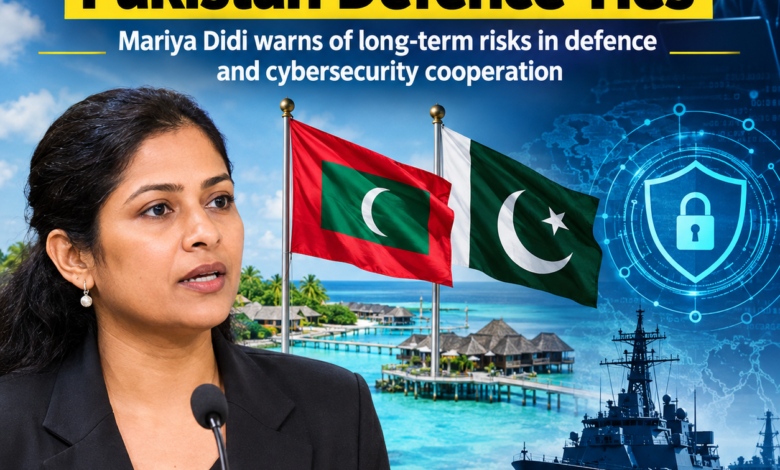
Maldives Urged to Review Pakistan Defence Ties
October 30, 2026: The Maldives has been urged to carefully examine its expanding defence and cybersecurity cooperation with Pakistan, with former Maldivian defence minister Mariya Didi warning that security agreements could have long-term consequences for the country’s sovereignty, regional relationships and economic stability.
Didi’s comments followed Maldivian President Mohamed Muizzu’s state visit to Pakistan from October 20 to 22. During the visit, the two countries exchanged 20 memoranda of understanding covering areas including defence, maritime security, cybersecurity, artificial intelligence, education, healthcare, tourism and trade. Presidency
The agreements came as Maldives and Pakistan marked 60 years of diplomatic relations. While Didi acknowledged the potential benefits of stronger bilateral cooperation, she said agreements involving national security and sensitive technology deserved closer public and institutional scrutiny.
According to Didi, the Maldives occupies an important strategic position along major Indian Ocean shipping routes. Its maritime territory and heavy dependence on tourism make stability and security particularly important to the island nation.
Defence Cooperation Raises Strategic Questions
Didi said international defence cooperation can help the Maldives improve maritime surveillance, combat illegal fishing and trafficking, protect critical infrastructure and respond to emergencies.
However, she cautioned that defence partnerships can also create long-term dependencies through military training, intelligence cooperation, equipment procurement and technical assistance.
She called for greater transparency about the newly signed defence and maritime-security agreements, including their financial obligations, operational commitments and provisions allowing agreements to be reviewed or terminated.
The former minister also questioned whether any arrangements could involve intelligence-sharing or access to sensitive maritime information. She argued that safeguards should be clearly established before such cooperation develops into long-term strategic dependence.
The Maldives has maintained relationships with both India and Pakistan. Didi stressed that maintaining relations with Islamabad does not inherently conflict with the Maldives’ relationship with New Delhi.
However, she argued that Maldivian diplomacy should remain clear enough to prevent bilateral engagements from being interpreted as support for positions the country has not formally adopted.
India remains an important partner for the Maldives in areas including maritime security, economic development, regional connectivity and emergency assistance, while Pakistan has maintained longstanding diplomatic relations with the island nation.
Cybersecurity Cooperation Under the Spotlight
One of the agreements signed during Muizzu’s Pakistan visit focuses on information technology, cybersecurity, artificial intelligence, digital skills, technology and innovation.
Didi said such cooperation could provide valuable opportunities for strengthening Maldivian technological capabilities and developing skilled professionals.
At the same time, she warned that cybersecurity partnerships can involve access to sensitive systems, information and infrastructure depending on how agreements are implemented.
There is no publicly established evidence that the Pakistan agreement gives Pakistani authorities access to Maldivian government data. However, Didi said questions surrounding data ownership, storage, system access and foreign technical involvement should receive careful attention.
She called for strong safeguards covering data sovereignty, access controls, information-sharing, independent audits and protection of critical infrastructure.
Regional Rivalry Could Test Maldives
The wider concern is the possibility that growing security cooperation could become more significant if tensions between India and Pakistan intensify.
Didi said the Maldives should establish clear boundaries before any regional crisis develops. Strategic autonomy, she argued, should mean maintaining the ability to make independent decisions rather than becoming dependent on any particular external power.
She also warned that geopolitical competition increasingly extends beyond conventional military activity. Intelligence operations, cyber activities, political influence and access to strategic infrastructure can all become components of wider competition.
For the Maldives, maintaining a neutral and predictable foreign-policy position could therefore be important to protecting both national security and international confidence.
Tourism Remains a Major Economic Concern
Didi further highlighted the potential economic consequences of regional instability. Tourism is central to the Maldivian economy, supporting resorts, airlines, restaurants, transport companies and numerous small businesses.
The Maldives recorded approximately 2.25 million tourist arrivals in 2025, according to official statistics cited in the report. A perception that the country was becoming caught in regional strategic competition could potentially affect visitor confidence and economic activity.
Regional instability could also increase transportation and insurance costs, disrupt travel routes and create pressure on foreign-exchange earnings.
Didi’s central argument is that the Maldives should maintain constructive relationships with multiple countries while ensuring that security partnerships do not compromise sovereignty or strategic independence.
The Pakistan agreements could provide opportunities in defence, technology, education and trade. But their long-term significance will depend on how they are implemented, what safeguards are established and whether the Maldives can maintain freedom of action in a changing Indian Ocean security environment.
The debate therefore extends beyond the Maldives-Pakistan relationship. It reflects the broader strategic competition developing across the Indian Ocean, where smaller nations increasingly have to balance economic opportunities, security partnerships and relationships with larger regional powers.